Homenatge a la Pagesía de Viladecans
|
|
|
||
|
|
|||
| Work
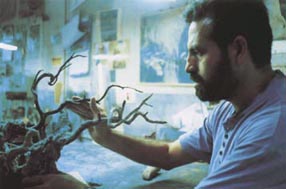
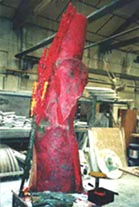
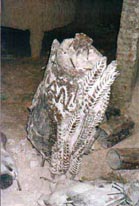
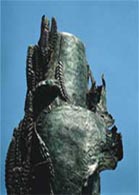
process of the sculpture Homenatge a la Pagesía de Viladecans |
|||
|
|
|
|
|
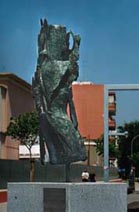
| The sculpture in its location (Castelldefels, Barcelona) | |||
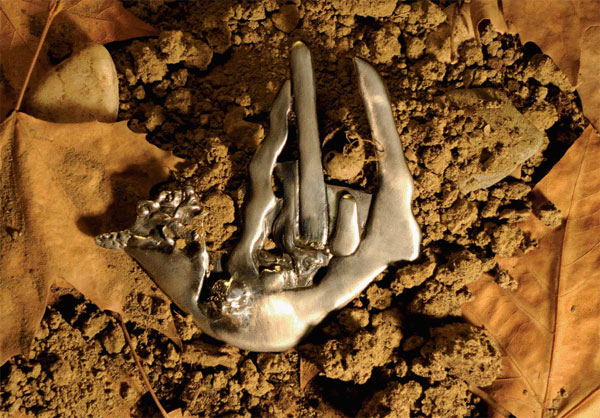 |
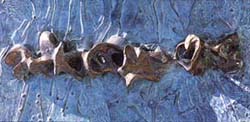
| Vessel. Silver bas-relief, 2009. 14,5x15x1 cm. Photograph by Charo J. Olmos |
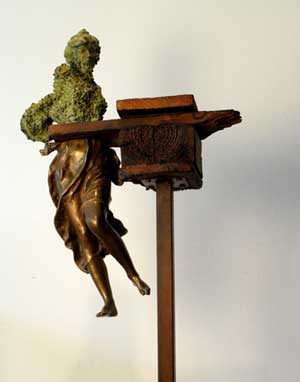
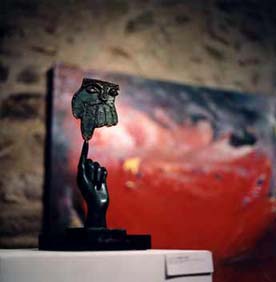
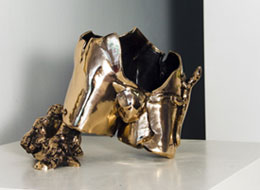
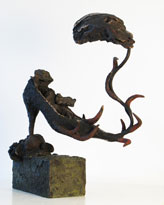
Hervás' sculpture has little to do with his paintings. The latter constantly invite us to enter a poetic and vaporous universe which can conceal the violent desire, the untrodden cove, or the calmed backwater with the condition, however, that the beholder will always have to be the one that wanders around it, that invents it. His sculpture, on the other hand, presents bronze allegories consciously contrived by the artist as an ordered multiplicity of elements whose predetermined purport the beholder must gradually discover, not invent. |
 |
 |
Sculptures in the Otzenhausen Europäische Akademie (Germany) for celtic sites,
within the international project “Cerda & Celtoi” |
|
One could say that the artist is allowing himself to be dragged along by the very nature of the materials he works with: the fragility of those he uses in his paintings, which suggests and flies away; and the gravity of those he uses in his sculptures, which determine the course and are always in command. (…) The gaze of the artist has scrutinised the multiplex matter, has glided along the moving surfaces of the sea and of the fields, has penetrated the dark coves and the foreseen gullies, has strayed amidst the fog and the snow; in such a way that he has felt the drive to tread upon, and to touch and feel all that his gaze was summoning him to walk upon, to touch and to feel, until he has come upon that old object, already forgotten, refusing to give it a new meaning, a surreal presence, and wanting only to touch it, with a touch which is neither absent-minded nor anonymous, but rather the intense touch of his acute subjectivity. |
|
 |
 |
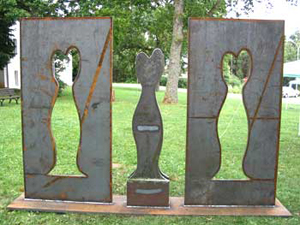
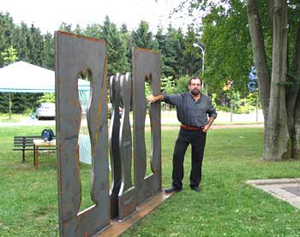
Works inspired by the novels of Antonio Muñoz Molina In the absence of Blanca (left) and Beltenebros (right) |
|
It is necessary to repeat this: he has not transfigured the object; he has only seen it, trod upon it, touched it. It is the artist's own way to tell the beholder: touch, tread upon, look at things for yourself; create them and re-create them, because no special talent has been bestowed upon me; you, too, can move beyond beholding and touching "the way everybody does". |
|
 |
|
 |
|||
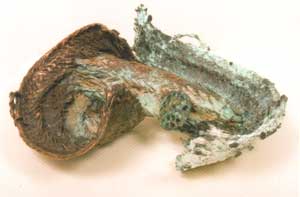
Troballa. Bronze sculpture using the lost wax. 70x56x28 cm, 2009. Property of Lourdes Mtnez. del Amo. |
|||||
 |
 |
||||
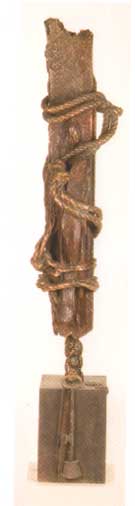
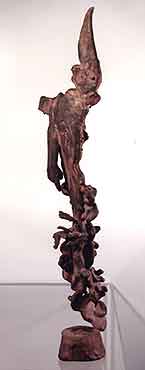
Above: Beatus Ille. Bronze sculpture using the lost wax. Single piece. 121x18x17,5 cm, 2009 |
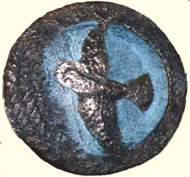
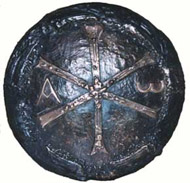
Above: bronze medallions made for the interior of the church of El Salvador, Jaén |
||||
 |
 |
||||
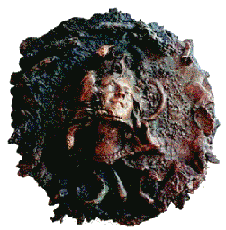
Medusa.
Medusa. Bronze, 1996. Inspired by a Roman work of the Museu de L'Hospitalet |
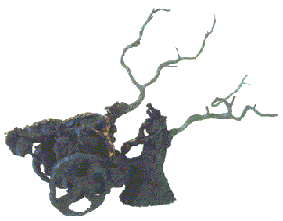
Carro. Bronze. 1994. Single piece |
||||
 |
 |
||||
| Sylnor. Bronze, 2002 | |||||
Homage to Ángel Ganivet |
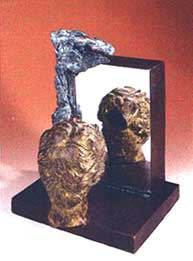
Below: Offering. Bronze, 1998. Adaptation to an object, in this case a modernist mirror | ||||
 |
 |
||||
Detail of one of the bronze reliefs of Francesc Macià square, Gavá (Barcelona) |
|||||
 |
 |
||||